

Expansion joints are critical components in industrial piping systems. They are designed to absorb thermal expansion, mechanical vibration, equipment movement and pipeline displacement caused by temperature changes, pressure fluctuations and operating conditions.
In many industrial applications, engineers need to choose between two common types of expansion joints:
Although both products are used to compensate pipeline movement, their design principles, material characteristics and application fields are significantly different.
Selecting the correct expansion joint is essential for ensuring pipeline safety, reducing maintenance costs and extending equipment service life.
As a professional expansion joint manufacturer in China, Hongze Pipe provides customized rubber expansion joints, metal bellows expansion joints and flexible pipeline solutions for global industrial projects.
1. What Is an Expansion Joint?
An expansion joint is a flexible connection installed in a piping system to absorb movement and reduce stress caused by thermal expansion, vibration or misalignment.
During operation, pipelines experience different types of movement:
Thermal Expansion
When pipeline temperature increases, the pipe expands. Without proper compensation, excessive stress may occur at:
- Flanges
- Valves
- Pumps
- Welded connections
- Supports
Mechanical Vibration
Equipment such as pumps, compressors and motors generates vibration that can transfer into pipelines.
Expansion joints help isolate vibration and reduce mechanical damage.
Installation Misalignment
During pipeline installation, small alignment errors may occur. Flexible expansion joints can compensate for minor installation deviations.
2. What Is a Rubber Expansion Joint?
A rubber expansion joint is a flexible connector manufactured with rubber bellows and reinforcement layers.
The main components include:
- Rubber body
- Reinforcement fabric layers
- Flanges
- Retaining rings (optional)
The rubber body provides flexibility, while reinforcement layers improve pressure resistance and structural stability.
Common rubber materials include:
EPDM Rubber Expansion Joint
EPDM is one of the most widely used materials.
Typical applications:
- Water supply systems
- Cooling water pipelines
- HVAC systems
- Wastewater treatment plants
Advantages:
- Excellent weather resistance
- Good aging resistance
- Good resistance to hot water and steam
- Suitable for outdoor applications
NBR Rubber Expansion Joint
NBR is commonly selected for oil-related applications.
Applications:
- Fuel pipelines
- Hydraulic systems
- Oil transfer systems
Advantages:
- Excellent oil resistance
- Good mechanical strength
FKM (Viton) Rubber Expansion Joint
FKM is used for more demanding chemical and temperature conditions.
Applications:
- Chemical processing
- Petroleum systems
- High-temperature oil pipelines
Advantages:
- Excellent chemical resistance
- High-temperature performance
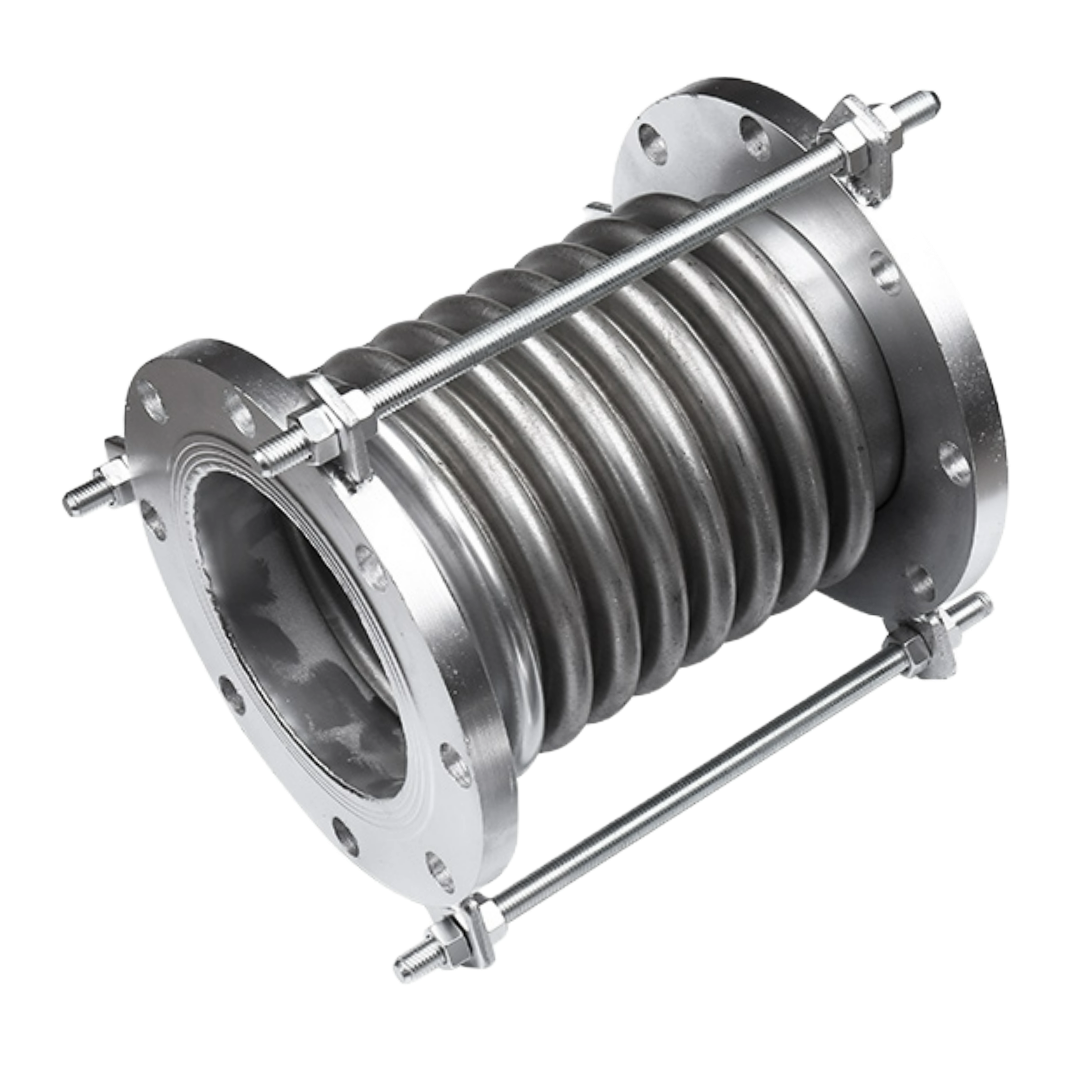
3. What Is a Metal Expansion Joint?
A metal expansion joint uses flexible metal bellows as the movement compensation element.
The main components include:
- Stainless steel bellows
- End connections
- Flanges or welding ends
- Tie rods and guides (depending on design)
The corrugated bellows structure allows controlled movement while maintaining pressure resistance.
Common materials:
- Stainless Steel 304
- Stainless Steel 316L
- Duplex Stainless Steel
- Inconel Alloy
Metal expansion joints are widely used in industries requiring high temperature resistance and mechanical strength.
4. Structural Difference Between Rubber and Metal Expansion Joints
| Item | Rubber Expansion Joint | Metal Expansion Joint |
|---|---|---|
| Flexible Element | Rubber bellows | Metal bellows |
| Main Function | Vibration absorption and flexibility | Thermal movement compensation |
| Temperature Resistance | Medium temperature applications | High temperature applications |
| Vibration Isolation | Excellent | Moderate |
| Chemical Resistance | Depends on rubber type | Depends on metal material |
| Maintenance Requirement | Regular inspection recommended | Requires professional design |
| Typical Applications | Pumps, water systems | Steam, power, chemical systems |
5. Temperature Performance Comparison
Temperature is one of the most important factors when selecting an expansion joint.
Rubber Expansion Joint Temperature Range
Different rubber compounds have different temperature limits.
EPDM
Suitable for:
- Water
- Cooling systems
- General industrial applications
Typical temperature:
-40°C to +120°C
NBR
Suitable for:
- Oil
- Fuel
- Hydraulic systems
Typical temperature:
-20°C to +100°C
FKM
Suitable for:
- Chemical applications
- High-temperature oil systems
Higher temperature resistance compared with standard rubber materials.
Metal Expansion Joint Temperature Capability
Metal expansion joints are preferred for high-temperature applications.
Examples:
- Steam pipelines
- Exhaust systems
- Furnace systems
- Power plants
- Petrochemical equipment
Depending on material selection, metal expansion joints can withstand several hundred degrees Celsius.
6. Vibration Absorption and Noise Reduction
One of the biggest advantages of rubber expansion joints is vibration control.
Industrial equipment such as pumps often creates:
- Mechanical vibration
- Pressure pulsation
- Noise transmission
Rubber expansion joints act as flexible isolation components.
They are commonly installed at:
- Pump suction pipelines
- Pump discharge pipelines
- Fan connections
- Compressor systems
Benefits include:
- Reduced vibration transmission
- Lower operating noise
- Protection of connected equipment
Metal expansion joints can compensate movement effectively but generally provide less vibration isolation compared with rubber types.
7. Pressure and Movement Capability
Rubber Expansion Joint
Rubber expansion joints are widely used in low and medium pressure systems.
Common pressure ratings:
- PN10
- PN16
- PN25
- ANSI Class 150
Movement capabilities include:
- Axial compression
- Axial extension
- Lateral movement
- Angular movement
Metal Expansion Joint
Metal expansion joints are designed for more demanding conditions.
Applications include:
- High temperature pipelines
- Long-distance pipelines
- Chemical processing systems
They can be designed according to:
- EJMA standards
- ASME requirements
Movement types:
- Axial movement
- Lateral movement
- Angular rotation
8. Application Areas Comparison
Rubber Expansion Joint Applications
Rubber expansion joints are widely used in:
Water Treatment Industry
- Water pumps
- Filtration systems
- Distribution pipelines
HVAC Systems
- Cooling water
- Chilled water pipelines
- Air conditioning systems
Industrial Equipment
- Pump connections
- Mechanical equipment connections
- Vibration isolation systems
Metal Expansion Joint Applications
Metal expansion joints are commonly used in:
Oil & Gas Industry
- Process pipelines
- Refinery systems
- Offshore facilities
Power Industry
- Steam pipelines
- Boiler systems
- Exhaust ducts
Chemical Industry
- High-temperature chemical pipelines
- Corrosive process systems
9. How to Choose Between Rubber and Metal Expansion Joint?
Engineers should evaluate the following parameters:
1. Operating Temperature
- Below 120°C: Rubber may be suitable
- High temperature: Metal is usually preferred
2. Medium
Consider:
- Water
- Oil
- Gas
- Chemicals
- Steam
Select suitable rubber compound or metal material.
3. Pressure
Confirm:
- Working pressure
- Test pressure
- Pressure fluctuation
4. Movement Requirements
Check:
- Axial movement
- Lateral movement
- Angular movement
5. Installation Location
Consider:
- Indoor or outdoor installation
- Space limitations
- Equipment vibration
10. Why Choose Hongze Pipe Expansion Joints?
Hongze Pipe specializes in manufacturing industrial pipeline expansion solutions.
Our products include:
We provide:
- Customized design
- Various flange standards
- Multiple rubber materials
- Industrial application solutions
Our engineering team selects suitable materials and structures according to:
- Pressure requirements
- Temperature conditions
- Medium characteristics
- Pipeline movement
Conclusion
Both rubber expansion joints and metal expansion joints play important roles in industrial piping systems.
Rubber expansion joints are ideal for applications requiring:
- Excellent vibration absorption
- Noise reduction
- Flexible connection
- Equipment protection
Metal expansion joints are better suited for:
- High-temperature applications
- Severe operating conditions
- Large thermal movements
The correct choice depends on the actual pipeline requirements.
Working with an experienced expansion joint manufacturer helps ensure reliable performance, longer service life and reduced maintenance costs.
About Hongze Pipe
Zhengzhou Hongze Valve Pipeline Equipment Co., Ltd. is a professional manufacturer of rubber expansion joints, metal expansion joints, flexible hoses, valves and industrial pipeline equipment.
Website: https://hongzepipe.com
Email: export@hongzepipe.com