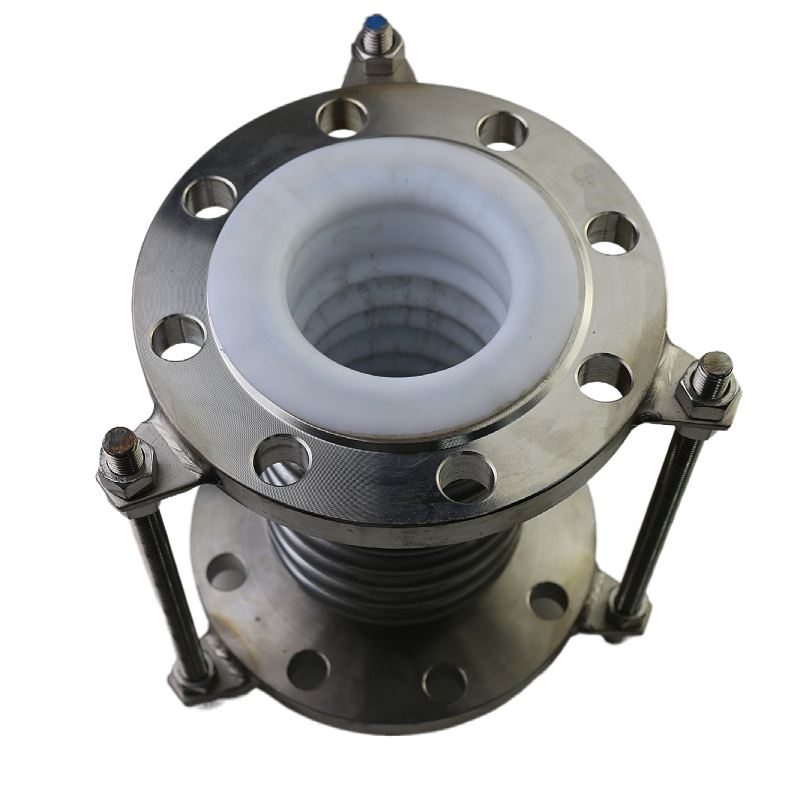
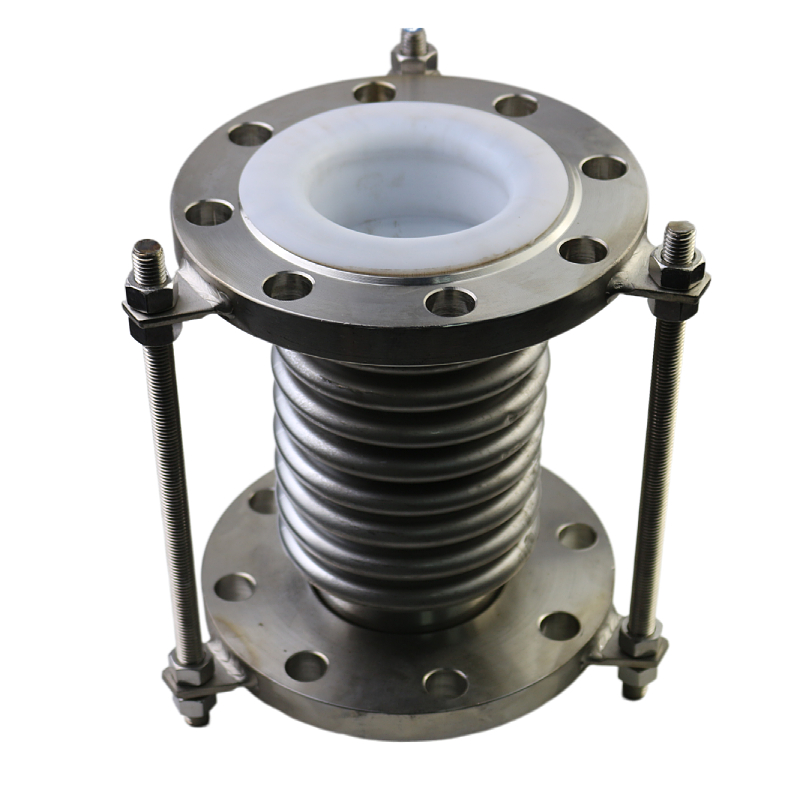
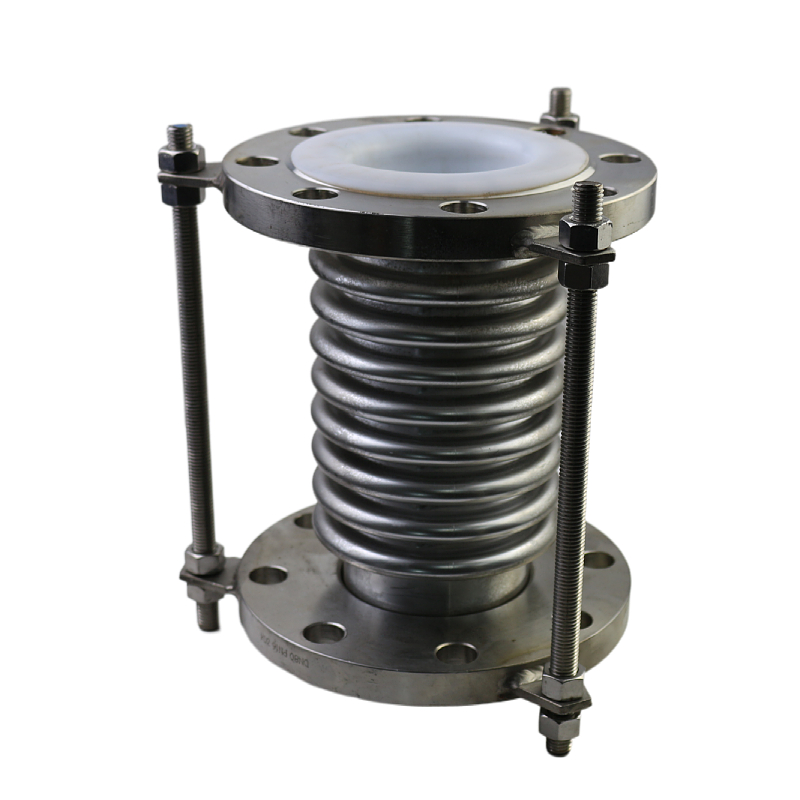
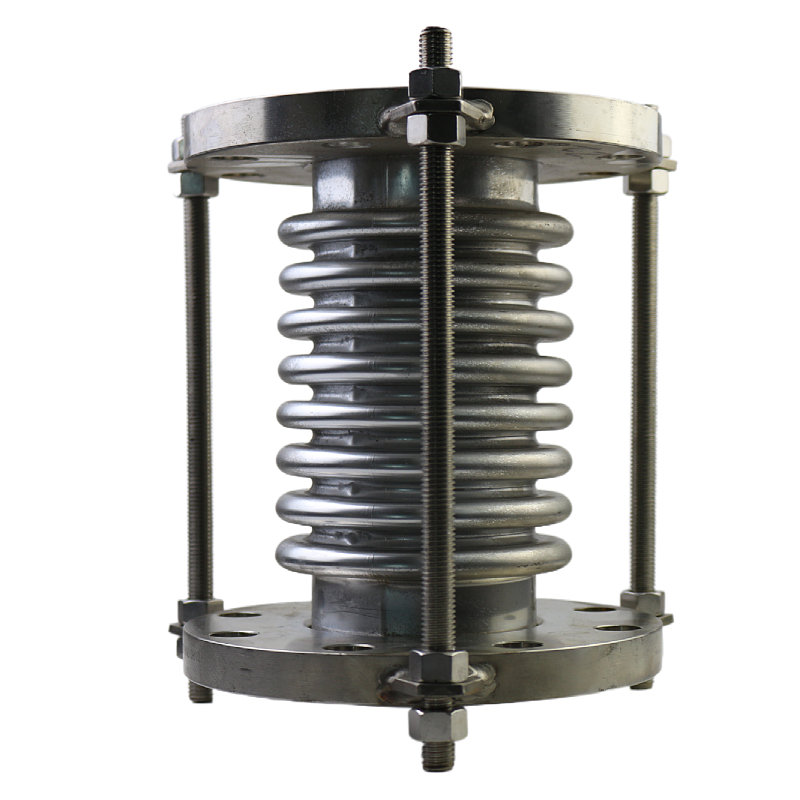
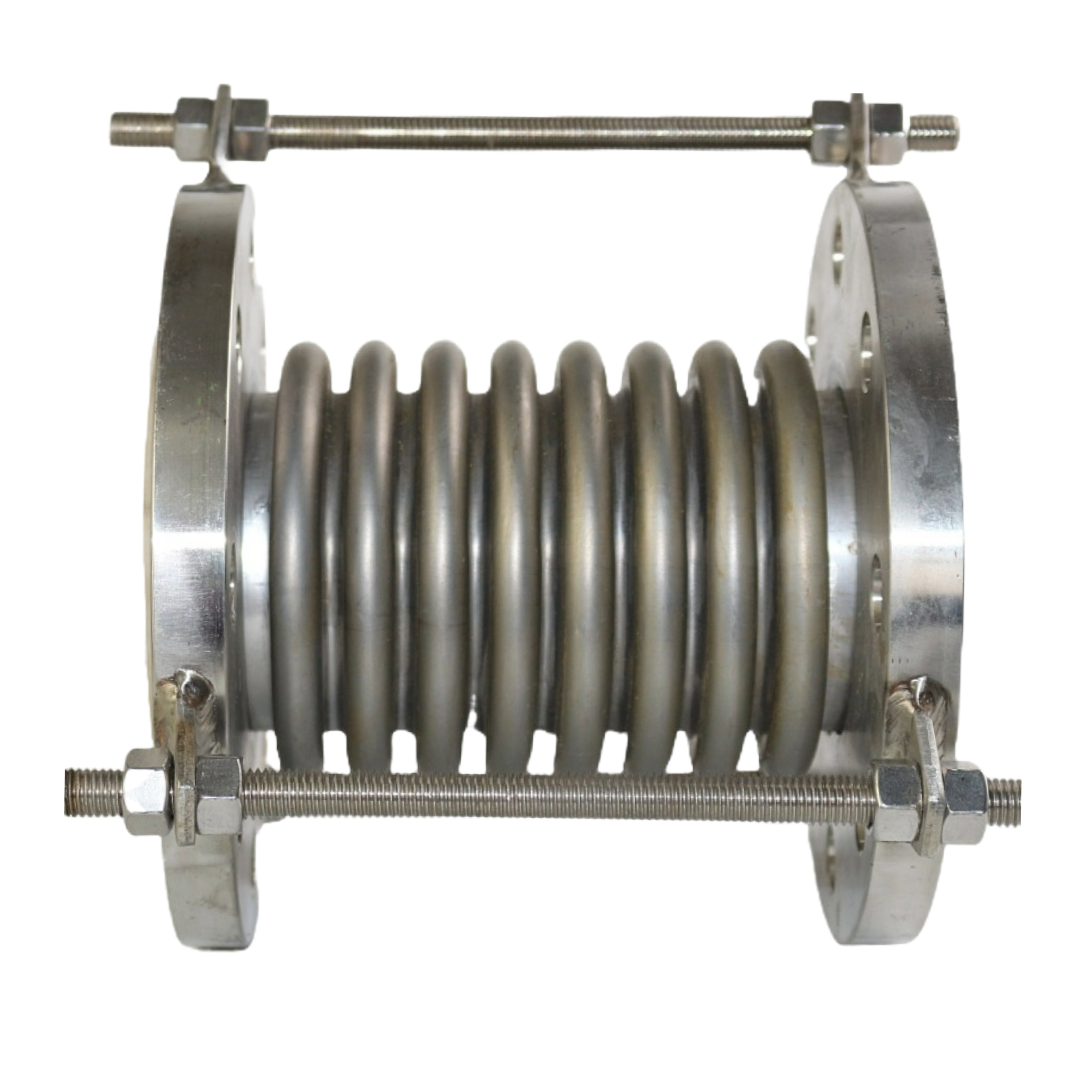
Metal Bellows Expansion Joint
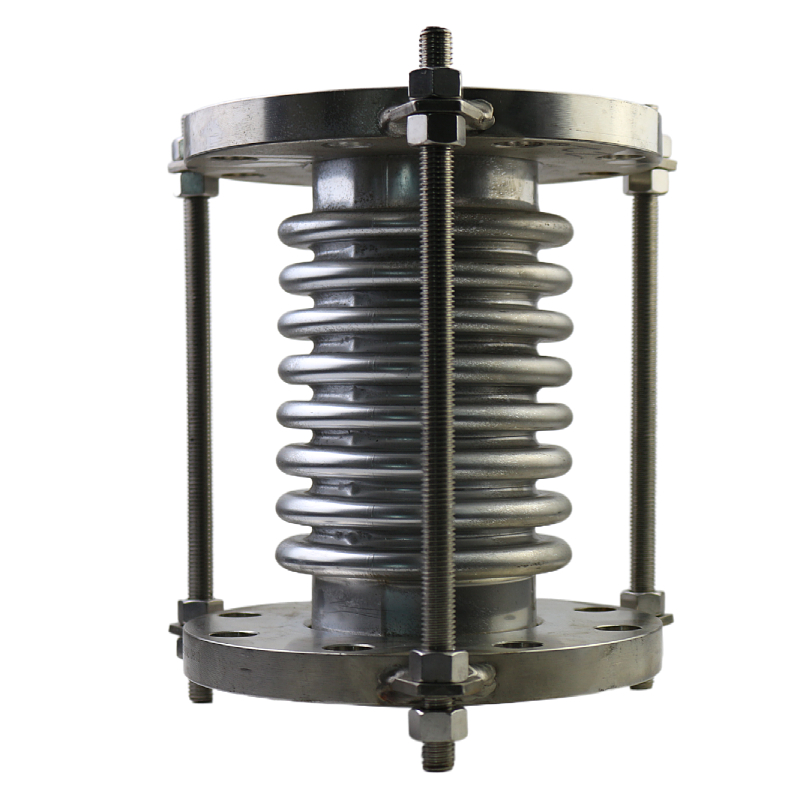
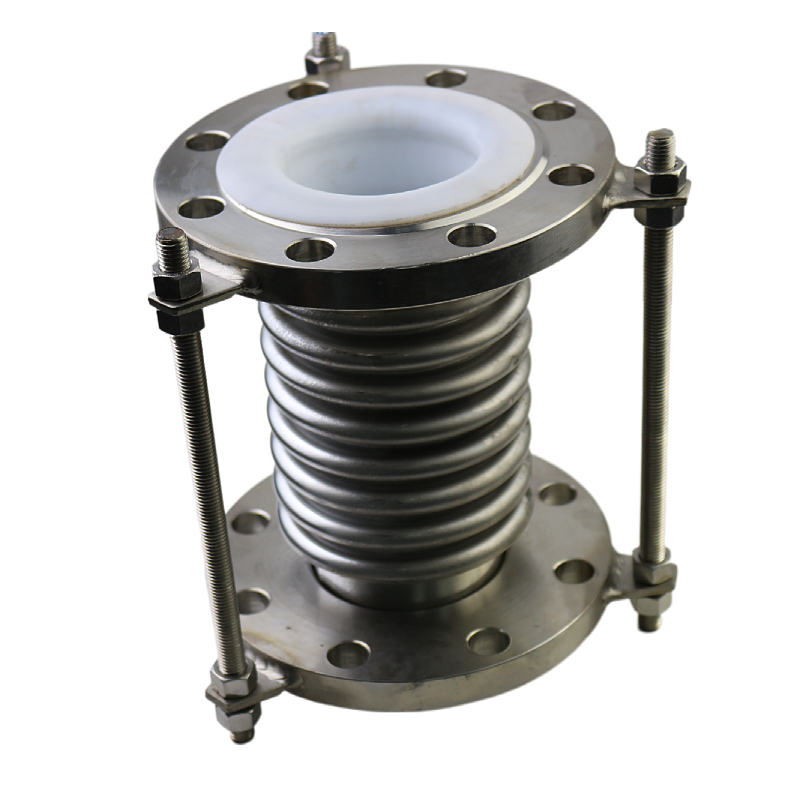
Hongze Metal Bellows Expansion Joint is a flexible piping component designed to absorb thermal expansion and contraction in industrial pipelines. The standard axial configuration uses formed stainless steel bellows as the flexible element and can be supplied with flanged ends or weld-end pipe connections. The number of convolutions, bellows geometry, material, pressure rating and overall length are selected according to the required movement, spring rate and design conditions.
Also known as a stainless steel bellows compensator or axial expansion joint, this product helps control thermal movement while transmitting predictable spring forces into the piping system. It is used in steam, hot water, thermal oil, gas, chemical, power-generation, district-heating, HVAC and general industrial pipelines when the bellows material is compatible with the medium and temperature.
Catalog selection data covers DN32 to DN1000, pressure classes from 0.25 to 2.5 MPa where listed, and multiple convolution quantities. Larger diameters, higher movement, non-standard lengths, special materials, rectangular or circular designs, and project-specific connection arrangements can be manufactured after engineering review. Hongze can produce metal expansion joints according to approved customer drawings or develop a production drawing from complete operating data.
Key Features and Benefits
- Absorbs axial thermal expansion and contraction in straight pipeline runs.
- Stainless steel bellows provide flexibility for high-temperature industrial service.
- Available with flanged ends or weld-end pipe connections.
- Catalog pressure selections from 0.25 MPa to 2.5 MPa, subject to the listed DN and convolution arrangement.
- Multiple convolution quantities allow movement and axial spring rate to be optimized.
- Bellows materials include SS304, SS316L and SS321, with other alloys evaluated for special media and temperature.
- Carbon steel, stainless steel or project-specified end connections can be evaluated.
- Internal sleeves can reduce direct flow impingement, turbulence and bellows erosion.
- External covers can protect the bellows from mechanical damage and external debris.
- Tie rods, limit rods, hinges, gimbals or pressure-balanced arrangements can be designed for specific movement and restraint requirements.
- Large diameters and non-standard pressure, movement and length combinations are available according to approved drawings.
- Suitable for new construction, replacement projects and equipment connections after pipe-stress review.
General Product Specifications
| Specification | Standard or Available Option |
|---|---|
| Product name | Metal Bellows Expansion Joint |
| Alternative names | Axial Expansion Joint, Stainless Steel Bellows Compensator, Metal Expansion Compensator |
| Catalog nominal diameter | DN32-DN1000 |
| Custom diameter | Large diameters above DN1000 and non-standard circular or rectangular sizes can be evaluated from drawings |
| Catalog pressure classes | 0.25, 0.6, 1.0, 1.6 and 2.5 MPa where listed |
| Primary catalog movement | Axial compression or extension |
| Other engineered movements | Lateral and angular movement using universal, hinged, gimbal or other designed configurations |
| Bellows materials | SS304, SS316L, SS321 or project-specific stainless steel/nickel alloy after compatibility review |
| End connections | Flanged ends, weld-end pipe connections or drawing-specific connections |
| Flange standards | ASME/ANSI, EN, DIN, JIS, BS, GB, HG or custom drilling |
| End-pipe material | Carbon steel, stainless steel or specified alloy compatible with the piping system |
| Accessories | Internal sleeve, external cover, tie rods, limit rods, hinges, gimbals, pantographic linkage or insulation |
| Design inputs | Pressure, temperature, medium, movement, cycles, connection loads, corrosion allowance, vacuum and installation conditions |
| Customization | Diameter, bellows geometry, ply construction, convolutions, material, pressure, movement, spring rate, length and accessories |
| Drawing production | Manufactured to an approved customer drawing or a Hongze production drawing developed from complete project data |
Important: A catalog DN and pressure class do not completely define a metal expansion joint. Temperature, movement, cycle life, bellows material, corrosion, vacuum, spring rate, pressure thrust, end connections, anchors and guides must be reviewed together. Final performance follows the approved calculation and production drawing.
Construction and Available Materials
| Component | Typical Material or Option | Function |
|---|---|---|
| Bellows | SS304, SS316L, SS321 or selected alloy | Flexible pressure-containing element that absorbs specified movement |
| End pipe | Carbon steel, stainless steel or project-specified alloy | Provides weld-end connection and transition to the bellows |
| Flanges | Carbon steel, low-alloy steel, stainless steel or specified material | Bolted connection to mating equipment or pipeline flanges |
| Internal sleeve | Stainless steel or material compatible with the medium | Protects convolutions from high flow velocity, turbulence, abrasion and deposits |
| External cover | Carbon steel or stainless steel | Protects the bellows from external impact and foreign material |
| Tie or limit rods | Carbon steel, alloy steel or stainless steel | Restricts selected movement or carries designed loads according to the joint configuration |
| Hinges or gimbals | Engineered carbon steel, alloy steel or stainless steel hardware | Controls angular movement and can restrain pressure thrust in the designed plane or planes |
| Weld filler | Selected to match the bellows and attachment materials | Provides compatible, qualified attachment welds |
Bellows Material Selection
| Bellows Material | Typical Use | Selection Note |
|---|---|---|
| SS304 | General water, hot water, air and non-severe industrial service | Confirm chloride content, temperature and external corrosion exposure |
| SS316L | Chemical, marine and chloride-containing service requiring improved corrosion resistance | Not immune to every chloride concentration or corrosion mechanism |
| SS321 | Elevated-temperature service where stabilized stainless steel is preferred | Actual temperature limit depends on design stress, cycles, medium and fabrication |
| Nickel alloy | Selected severe corrosion or high-temperature applications | Exact alloy must be chosen from complete process chemistry and design conditions |
| Multi-ply construction | Applications requiring a designed balance of flexibility, pressure capacity and monitoring | Ply quantity and thickness require calculation; more plies do not automatically mean higher pressure |
The bellows material must be checked against both the internal medium and the external environment. Condensation, chlorides, insulation, washdown chemicals and atmospheric contamination can cause external corrosion even when the process medium is compatible.
Expansion Joint Configurations
| Configuration | Primary Movement | Pressure-Thrust Behavior | Typical Application |
|---|---|---|---|
| Unrestrained axial | Axial compression and extension | Pipeline main anchors must normally resist bellows pressure thrust | Straight pipe run with engineered anchors and guides |
| Tied universal | Lateral movement | Tie rods are designed to restrain pressure thrust; axial movement is restricted | Equipment connections and offset piping |
| Hinged | Angular rotation in one plane | Hinge hardware is designed to carry pressure thrust | Two- or three-joint piping systems with planned angular rotation |
| Gimbal | Angular rotation in multiple planes | Gimbal hardware is designed to carry pressure thrust | Three-dimensional piping movement |
| Pressure balanced | Axial and/or lateral movement depending on arrangement | Balancing bellows reduce externally transmitted pressure thrust | Turbines, pumps, vessels and systems where main-anchor loads must be reduced |
| Externally pressurized | Large axial movement | Requires engineered anchors or restraint according to configuration | Long thermal movement with improved column stability |
The catalog table below primarily supports initial selection of an axial metal bellows expansion joint. Lateral, hinged, gimbal and pressure-balanced designs require separate calculations and drawings; their movement and length must not be copied from the axial table.
How to Read the Catalog Table
- DN: Nominal pipeline diameter.
- Convolutions: Number of bellows corrugations in the catalog arrangement.
- Compensation / stiffness: Each pressure cell is written as axial compensation in millimetres / axial spring rate in N/mm.
- Effective area: Bellows effective pressure area used when evaluating pressure thrust.
- Maximum outside diameter: Reference envelope diameter for preliminary layout.
- Flanged length: Catalog length for flanged-end arrangements. Slash-separated values represent catalog alternatives.
- Pipe-end length: Catalog length for weld-end connection-pipe arrangements. Slash-separated values represent catalog alternatives.
- Blank cell: No catalog value is provided; do not interpolate or assume availability.
Catalog Dimensions, Axial Movement and Spring Rate
The following 40 rows preserve the supplied catalog values. They are reference data for preliminary selection only. Several source values show alternative lengths, and a few catalog length combinations appear non-sequential; therefore, the approved production drawing always controls manufacturing and installation dimensions.
| DN | Convolutions | 0.25 MPa Movement / Stiffness |
0.6 MPa Movement / Stiffness |
1.0 MPa Movement / Stiffness |
1.6 MPa Movement / Stiffness |
2.5 MPa Movement / Stiffness |
Effective Area (cm²) | Maximum OD (mm) | Flanged Length (mm) | Pipe-End Length (mm) |
|---|---|---|---|---|---|---|---|---|---|---|
| DN32 | 8 | 25 / 21 | 22 / 26 | 20 / 26 | 18 / 63 | — | 16 | 225 | 160 / 250 | 264 / 280 |
| DN32 | 16 | 50 / 11 | 46 / 14 | 41 / 14 | 36 / 32 | — | 16 | 225 | 224 / 291 | 316 / 321 |
| DN40 | 8 | 25 / 28 | 22 / 44 | 20 / 44 | 18 / 89 | 15 / 98 | 23 | 244 | 164 / 259 | 269 / 289 |
| DN40 | 16 | 50 / 14 | 46 / 22 | 41 / 22 | 36 / 45 | 31 / 47 | 23 | 244 | 230 / 304 | 319 / 334 |
| DN50 | 8 | 25 / 30 | 22 / 51 | 20 / 70 | 18 / 70 | 15 / 106 | 37 | 259 | 172 / 276 | 282 / 306 |
| DN50 | 16 | 50 / 16 | 46 / 26 | 41 / 35 | 36 / 35 | 31 / 55 | 37 | 259 | 240 / 342 | 347 / 372 |
| DN65 | 8 | 33 / 28 | 30 / 35 | 26 / 44 | 22 / 55 | 15 / 138 | 55 | 270 | 215 / 294 | 300 / 322 |
| DN65 | 12 | 42 / 16 | 38 / 22 | 38 / 32 | 34 / 40 | 31 / 70 | 55 | 270 | 260 / 334 | 340 / 362 |
| DN80 | 8 | 40 / 20 | 36 / 26 | 34 / 33 | 28 / 41 | 19 / 68 | 81 | 284 | 240 / 338 | 344 / 366 |
| DN80 | 10 | 53 / 14 | 49 / 17 | 49 / 21 | 43 / 26 | 29 / 50 | 81 | 284 | 270 / 368 | 374 / 390 |
| DN100 | 6 | 45 / 47 | 45 / 60 | 40 / 75 | 35 / 93 | 25 / 54 | 121 | 304 | 235 / 317 | 323 / 345 |
| DN100 | 10 | 76 / 26 | 74 / 32 | 64 / 40 | 57 / 50 | 38 / 33 | 121 | 304 | 305 / 381 | 387 / 409 |
| DN125 | 5 | 48 / 38 | 42 / 47 | 38 / 59 | 34 / 74 | 29 / 117 | 180 | 334 | 282 / 314 | 316 / 342 |
| DN125 | 9 | 85 / 23 | 77 / 29 | 66 / 36 | 58 / 45 | 49 / 63 | 180 | 334 | 382 / 386 | 388 / 414 |
| DN150 | 5 | 49 / 42 | 44 / 50 | 40 / 62 | 34 / 78 | 29 / 92 | 257 | 364 | 282 / 339 | 338 / 367 |
| DN150 | 8 | 79 / 34 | 71 / 43 | 64 / 51 | 54 / 59 | 50 / 56 | 257 | 364 | 356 / 399 | 402 / 427 |
| DN200 | 4 | 52 / 49 | 46 / 55 | 42 / 68 | 38 / 78 | 29 / 97 | 479 | 442 | 280 / 348 | 348 / 372 |
| DN200 | 6 | 73 / 31 | 65 / 44 | 59 / 52 | 53 / 58 | 46 / 65 | 479 | 442 | 340 / 402 | 402 / 426 |
| DN250 | 4 | 72 / 30 | 65 / 34 | 59 / 42 | 52 / 45 | 34 / 111 | 769 | 507 | 315 / 379 | 415 / 379 |
| DN250 | 6 | 108 / 16 | 97 / 21 | 87 / 35 | 79 / 39 | 48 / 78 | 769 | 507 | 393 / 459 | 493 / 399 |
| DN300 | 4 | 72 / 51 | 65 / 55 | 59 / 59 | 52 / 65 | 47 / 55 | 1105 | 562 | 366 / 427 | 466 / 467 |
| DN300 | 6 | 108 / 32 | 97 / 35 | 87 / 37 | 79 / 41 | 71 / 47 | 1105 | 562 | 464 / 525 | 564 / 565 |
| DN350 | 4 | 72 / 58 | 65 / 62 | 59 / 67 | 52 / 74 | 47 / 71 | 1307 | 622 | 397 / 452 | 497 / 492 |
| DN350 | 6 | 108 / 38 | 97 / 41 | 87 / 44 | 79 / 48 | 71 / 45 | 1307 | 622 | 509 / 564 | 609 / 604 |
| DN400 | 4 | 72 / 54 | 65 / 58 | 59 / 62 | 52 / 68 | 47 / 81 | 1611 | 700 | 412 / 478 | 512 / 518 |
| DN400 | 6 | 108 / 36 | 97 / 39 | 87 / 43 | 79 / 47 | 71 / 47 | 1611 | 700 | 522 / 588 | 622 / 628 |
| DN450 | 4 | 108 / 32 | 97 / 35 | 87 / 37 | 79 / 41 | 47 / 75 | 1972 | 760 | 403 / 498 | 503 / 523 |
| DN450 | 6 | 162 / 20 | 145 / 22 | 131 / 23 | 118 / 25 | 71 / 52 | 1972 | 760 | 503 / 658 | 603 / 648 |
| DN500 | 4 | 108 / 59 | 97 / 64 | 87 / 68 | 79 / 75 | 71 / 45 | 2445 | 835 | 431 / 523 | 531 / 554 |
| DN500 | 6 | 162 / 34 | 145 / 37 | 131 / 39 | 118 / 43 | 106 / 28 | 2445 | 835 | 531 / 665 | 631 / 742 |
| DN600 | 4 | 108 / 74 | 97 / 80 | 87 / 85 | 79 / 94 | 71 / 82 | 3534 | 980 | 478 / 548 | 578 / 588 |
| DN600 | 6 | 162 / 42 | 145 / 45 | 131 / 49 | 118 / 53 | 106 / 48 | 3534 | 980 | 658 / 679 | 758 / 781 |
| DN700 | 4 | 108 / 67 | 97 / 72 | 87 / 77 | 79 / 85 | 71 / 103 | 4717 | 1110 | 490 | 590 |
| DN700 | 6 | 162 / 42 | 145 / 45 | 131 / 49 | 118 / 53 | 106 / 60 | 4717 | 1110 | 690 | 790 |
| DN800 | 4 | 120 / 88 | 108 / 95 | 102 / 102 | 94 / 112 | 71 / 95 | 5822 | 1265 | 502 | 602 |
| DN800 | 6 | 183 / 67 | 164 / 72 | 156 / 77 | 144 / 85 | 106 / 60 | 5822 | 1265 | 610 | 710 |
| DN900 | 4 | 120 / 84 | 108 / 90 | 102 / 97 | 94 / 107 | 82 / 123 | 7620 | 1186 | — | 698 |
| DN900 | 6 | 183 / 60 | 164 / 65 | 156 / 69 | 144 / 76 | 125 / 93 | 7620 | 1186 | — | 850 |
| DN1000 | 4 | 120 / 91 | 108 / 98 | 102 / 105 | 94 / 116 | 82 / 117 | 9043 | 1286 | — | 692 |
| DN1000 | 6 | 183 / 59 | 164 / 65 | 156 / 71 | 144 / 81 | 125 / 84 | 9043 | 1286 | — | 855 |
Table note: Movement values are millimetres and stiffness values are N/mm. They are not interchangeable. A longer or higher-convolution design can provide more movement but changes length, spring rate, stability and fatigue performance. Do not combine pressure, movement or length values from different rows.
Pressure Thrust and Spring Force
An unrestrained axial bellows generates forces that the piping system must carry. Two important components are pressure thrust and bellows spring force:
Pressure thrust: Fp = P × Ae
Axial spring force: Fs = K × X
Where P is internal pressure, Ae is bellows effective area, K is axial spring rate and X is axial movement. When P is entered in MPa and effective area in cm², pressure thrust in newtons is P × Ae × 100. The total anchor and equipment load can also include pipe friction, weight, dynamic loads, misalignment and other system forces.
Example: A DN500 catalog bellows has an effective area of 2445 cm². At 1.0 MPa, the calculated pressure thrust alone is approximately 244,500 N, before adding spring force and other loads. This is why large-diameter axial expansion joints require properly engineered main anchors and guides.
Large Diameter and Drawing-Based Customization
Hongze can manufacture large-diameter metal bellows expansion joints and non-standard compensators according to customer drawings. The catalog table reaches DN1000, but this is not the maximum possible diameter. Diameters above DN1000, duct expansion joints and special equipment connections are evaluated individually.
| Custom Design Item | Available Engineering Scope |
|---|---|
| Diameter and shape | Large circular diameter, non-standard bore, rectangular duct or transition geometry |
| Movement | Axial, lateral, angular or combined movement using a suitable joint configuration |
| Bellows construction | Convolution geometry, ply quantity, ply thickness and reinforced or externally pressurized arrangements |
| Material | SS304, SS316L, SS321 or project-specific alloy based on media and temperature |
| Connection | Flange, weld end, equipment nozzle, rectangular frame or drawing-specific interface |
| Overall length | Custom installed length based on available space and required movement |
| Accessories | Internal sleeve, cover, tie rods, limit rods, hinges, gimbals, balancing bellows and lifting points |
| Testing | Dimensional, visual, pressure, leak and specified NDT requirements according to the approved inspection plan |
| Documentation | Production drawing, material documents, test report, inspection records, marking and packaging requirements |
Data Required for Design From a Drawing
- Drawing: Send the existing product drawing, pipeline layout or equipment-nozzle drawing.
- Size: State DN, pipe outside diameter, wall thickness and bore requirements.
- Pressure: State design pressure, operating pressure, test pressure, surge and vacuum.
- Temperature: Give design, operating, minimum and upset temperatures.
- Medium: Provide fluid composition, concentration, phase, solids, corrosion and cleaning conditions.
- Movement: Give axial extension, axial compression, lateral offset and angular rotation separately.
- Cycles: State the required design cycles and expected operating frequency.
- Connections: Provide flange standard, class, facing, drilling or weld-end details.
- Installed length: State cold-face-to-face length and available installation tolerance.
- Restraint: Show anchors, guides, supports and allowable equipment-nozzle loads.
- Flow: Give velocity, direction, turbulence, pulsation and need for an internal sleeve.
- Environment: State indoor/outdoor exposure, insulation, chlorides and external corrosion.
Applications
- Steam and condensate pipelines
- Hot-water and district-heating networks
- Thermal-oil systems
- Power plants and boiler auxiliary piping
- Petrochemical and refinery pipelines
- Chemical-processing plants
- Oil and gas utility piping
- HVAC chilled-water and heating-water systems
- Exhaust, flue-gas and process-air ducts
- Pump, compressor, heat-exchanger, turbine and vessel connections
- Marine and industrial utility systems
- Large-diameter pipelines and custom equipment connections
Installation Guidelines
- Verify the approved drawing, flow direction, installed length, movement direction, material, pressure rating and accessories before installation.
- Inspect the bellows for dents, scratches, weld damage, contamination or distortion. Do not install a damaged bellows.
- Confirm main anchors, intermediate anchors, guides and supports are installed according to the pipe-stress design.
- Align mating connections without forcing the bellows to correct pipe misalignment.
- Do not twist the bellows. Torsion is highly damaging unless the product is specifically designed for it.
- Do not remove shipping bars until the joint is installed and the surrounding piping is correctly restrained. Shipping bars are not permanent tie rods unless the drawing states otherwise.
- Protect thin bellows material from welding arc strikes, grinding sparks, weld spatter and sharp tools.
- For weld-end products, prevent weld heat and purge contamination from damaging the bellows.
- Install the internal sleeve in the correct flow direction when the sleeve is directional.
- Do not exceed the specified cold preset, installation tolerance or combined movement.
- Remove temporary transport and installation restraints only in the sequence specified on the drawing.
- Perform controlled inspection and testing before operation, then recheck the joint during initial heating and cooling.
Inspection and Maintenance
- Inspect convolutions for dents, cracking, corrosion, thinning, abrasion and abnormal deformation.
- Check attachment welds, end pipes, flanges, tie rods, hinges and covers.
- Confirm the joint is not operating beyond its movement or alignment limits.
- Inspect anchors, guides and supports for movement, looseness or structural damage.
- Investigate changes in vibration, noise, pressure, temperature or process conditions.
- Check for external corrosion beneath insulation and around condensate traps.
- Never repair thin bellows convolutions by uncontrolled field welding.
- Replace or professionally evaluate a joint showing leakage, fatigue cracking, severe corrosion or permanent distortion.
Quality and Inspection Options
- Material verification and review of supplied material documents
- Dimensional inspection against the approved production drawing
- Visual examination of bellows and attachment welds
- Liquid-penetrant examination of specified stainless steel welds when required
- Pressure or leak testing according to the approved procedure
- Spring-rate or movement verification when specified and technically agreed
- Project marking, tagging, coating and packaging inspection
- Third-party inspection when included in the purchase requirements
Inspection scope, acceptance criteria and documentation must be agreed before production. Tests that are not specified in the purchase order should not be assumed.
Why Choose Hongze
- Selection support based on pressure, temperature, movement, cycles, spring rate and effective area.
- Catalog reference range from DN32 to DN1000.
- Large diameters and special structures evaluated according to drawings.
- Flanged, weld-end and project-specific connection options.
- SS304, SS316L, SS321 and special alloy bellows material evaluation.
- Internal sleeves, covers, tie rods, hinges, gimbals and pressure-balanced designs available.
- Production drawings can be confirmed before manufacturing.
- Direct technical communication for replacements, project drawings and customized quotations.
Frequently Asked Questions
What is a metal bellows expansion joint?
It is a flexible metal piping component that uses formed bellows to absorb specified thermal or mechanical movement while containing the design pressure.
What is the difference between movement and stiffness in the table?
Movement is the catalog axial compensation in millimetres. Stiffness is the axial spring rate in N/mm. Spring force equals stiffness multiplied by actual movement.
Why does one DN have more than one row?
Different convolution quantities provide different movement, spring rate and overall length. DN alone is therefore not enough to select the product.
Can the same expansion joint absorb axial, lateral and angular movement?
Only when specifically designed for the required combined movement. The catalog table is primarily axial. Universal, hinged, gimbal or pressure-balanced structures should be selected for other movement patterns.
What is bellows pressure thrust?
It is the force generated by internal pressure acting on the bellows effective area. In an unrestrained axial system, main anchors normally must carry this force in addition to spring and other piping loads.
Do tie rods allow axial movement?
Standard tie rods are commonly used to restrain pressure thrust and therefore restrict axial movement. Limit rods may allow a defined axial range. The exact function must follow the approved drawing.
Can large diameters above DN1000 be manufactured?
Yes, larger circular sizes and special duct expansion joints can be evaluated according to drawings, pressure, temperature, movement, material, transport and site-installation conditions.
Can Hongze manufacture from my drawing?
Yes. Send the drawing plus operating pressure, temperature, medium, movement, cycles, connection material and inspection requirements. The final production drawing should be approved before manufacture.
Which bellows material should I choose?
SS304 is used for many general services, SS316L may improve corrosion resistance in selected chemical or marine environments, and SS321 is often evaluated for elevated temperature. Final selection requires exact media and design conditions.
Is an internal sleeve required?
It may be required for high velocity, turbulent flow, abrasive particles, pulsation or when deposits could enter the convolutions. The sleeve can restrict movement in some configurations and must be designed with the joint.
Can a bellows compensate pipe misalignment?
No. Installation misalignment consumes movement capacity and creates unintended stress. Align the piping before installation unless the approved design explicitly includes an offset.
What information is required for a quotation?
Send DN, design and operating pressure, temperature, medium, axial/lateral/angular movement, cycles, installed length, connection details, bellows material, accessories, anchors, guides and a pipeline drawing.
Related Products
Request a Custom Bellows Expansion Joint Quotation
Send your drawing, DN, pressure, temperature, medium, movement, design cycles, installed length, connection standard, material and accessory requirements. Hongze will review bellows geometry, spring rate, effective area, pressure thrust and piping restraint before quotation.
WhatsApp: +86 15838027988
Email: export@hongzepipe.com
Contact: Send Your Drawing and Technical Requirements